Gravity Well Foundation
An Unclassified Forum Discussing Space Warfare Relevant Strategies, Scenarios, and Implementing Technology and Tactics
Hit the Down Arrow for the site's Purpose and Intent and the scientific definitions of the gravity well!
see
The Editors of this site have decided to focus our attentions on developing strategies for the United States for 3 areas of space: LEO, Moon, and Mars.
STAR SHIELD - the SpaceX LEO system.
The USA is in the early stages of giant tech breakouts in its ongoing competition with its earth competitors. There are at least 5 tech breakouts happening simultaneously (AI, Genetics, Robotics and Automation, Warfare, and Space). Our emphasis here is on Space, and its Defense.
Our approach on this site is to first establish a "first principle" definition of what our objectives are in each of the 3 areas (LEO, Moon and Mars) within our determined CONOPS of Mosaic Defense/offense, and then write a series of articles on each of the 3 areas.
SpaceX's "STARSHIELD" is likely the upcoming up and down control point for Earth-focused warfare. It is focused primarily on earth conflicts. It is starlink but adapted to military uses, including satellite to satellite laser light communications. Thus this is very important, but it is the baseline for Space warefare because it is primarily for use in earth based activities. This site focuses on in space and trans-space warfare, which is quite different.
Principles Framework
Any article on space defense strategy and how it would look like must first consider the context of the 4 types of defense: a) passive detection and resilience, b) passive detection and active resistance; c) defensive actions preemptively taken to thwart / reduce the likelihood of offense against us, d) offensive strikes to reduce / eliminate the ability to attack us in the first place.
Could this strategic thinking analysis framework be used in the LEO, for the Moon, and for Mars as well?
Mosaic Defense/Offense
In the recent Iran Major Combat Operation (2026), The evolving US and Iranian strategies reflect the rapidly changing battlefield concepts being employed very successfully by Ukraine in its on-going real war with Russia. This strategy is called "mosaic defense"; this strategy employs distributed command structures with a heavy emphasis on drones, robots, and AI, combined with satellite and information superiority. In this strategy, the intent is to create "Kill Zones" that provide for sustained superiority in the designated areas of the battle space. In this case, this is the strategy of the Defense of the Moon and Mars as extensions of US Territoral claims.
Mosaic Offense is the reciprocal of the defensive concepts; in Mosaic Offense, the same tools that are used to create extended kill zones are used to create "do not enter" zones, backed up by technology and numbers that create a close to unbreakable in-place superiority. The operational principle of Mosaic Defense/Offense is an asymmetric, distributed, AI driven choice system based on adaptive assessment of current and projected threats, objectives, and current situation awareness.
Why This Site Name
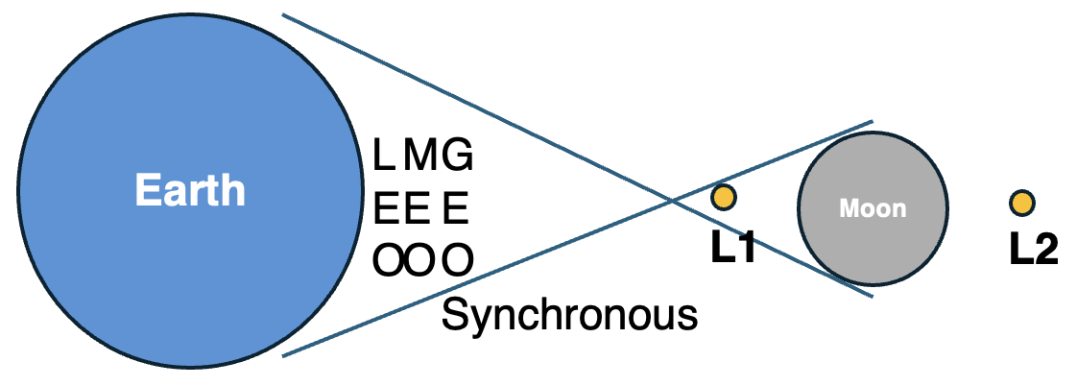
We call this Site " Gravity Well" because the three dominating factors framing these MOSAIC DEFENSE and MOSAIC OFFENSE reciprocal strategy are 1) the gravity well (the effects of gravity as a force eminating from the earth and the moon) as depicted (Earth, Moon and Sun) and hence the name of the site, 2) Space's Environmental Conditions , and 3) The Purpose and Intent of the United States of America's Strategic Interests in Space and what Defense strategies (amongst the 4 above within the concepts of operation for Mosaic Offense/Defense) work for it.
The now unstopable US Space tech breakout, already well underway, sees the US industrial/commerical sector leading the Defense Sector to the point that most of the innovation and costs of such are being borne by non-governmental companies with "dual-use" technologies, processes, and tangible results.
AI is a pervasive coming influencer on almost every aspect of the topics of this webiste. See each topic discussion on how AI is/will impact that area of discussion.
An initial article entitled "Ice Frontier" about Russia, and how Russia is approaching its geographic defense/offense, and how that is starting to apply to their LEO activites can be found on the Topical Discussions page.
Check out the NOAA site (https://www.nesdis.noaa.gov/news/points-of-lagrange-satellite-million-miles-home) for a Lagrange Point (L-1, and L-2 thru 5) overview.
This site greatly appreciates any meaningful comments, articles, or other submissions to advance the topics covered. We will gladly cite and reference any work or references; however, we reserve the exclusive and absolute right to accept or reject any submission, as we are mindful of the subject matter of this site and its ramifications.

Purpose and Intent
See the end of this section for the scientific definitions surrounding the gravity well
This site assumes that (a) someone or nation must act as the policeman of space around the earth, moon, and other planatary systems around our sun (sol) since it is in the interest of humankind for space to become humanized, and (b) at this point, from a United states of america perspective, the only reasonable policeman is the USA as it has the present capabilities and no reason to deny any ally or non-threatening actor access, but instead welcomes allies and partners in space, as all of humanity will need to be involved for humankind to become a space based civilization, and such an endeavour is extremely challenging.
The purpose of This Website, Papers, Forums and Podcasts / YouTube Channels, all planned for, will / and ARE discussing the unclassified views of those having some relevant experience in the field, and various associated subject matter, concerning Space Warfare as such is a vital and necessary part of the policing function.
This is not a science fiction or wild speculation forum, but instead discusses likely space warfare scenarios, and perhaps some unlikely ones, and how they would play-out within the context of the 3 key factors facing any realistic discussion of the application of known technologies, And The Contexts of the Strategies and Tactics which might employ such.
The primary CONOPS (see Concept of Operations page) of this site is that space warfare is by definition NOT executed from the earth, but is instead originated non-earth and exeuted in space without regard to earth unless an attack is originated from earth. This is because the time to communicate this far out from earth takes too long for effective c&c at any level of detail (1.25 seconds in each direction per transmission).
This is a very significant difference, and reflects the transformation of space warfare into a conceptual equivalent to various ocean warfare strategies, as if this were a earth based naval warfare discussion site. All elements of space warfare, including space based supply chains, manufacturing of systems, deployment and operations of systems, communications, and command and control, are considered to be space based, and while ultimate C&C will likely come from earth, all operational C&C would come from space based assets.
A good analogy might be PACOM, the US Pacific Command operating out of Hawaii, but in this case, C&C would come from a moon contigueous platform / base and this moon contigueous space would be it's operational theater, with most if not all deployable assets and manpower coming fROM, or at LEAST based in, such moon contigeous space because the time of transmission from earth to L-1 or moon assets takes too long for any but the most strategic communications to come from earth c&c.
the naval analogy applied writ large
a good place to start this discussion, using the PACOM frame of reference, is to discuss how to manage space "traffic". see US Patent Numbers 7,889,100 and 7,979,088, both describing a "Water friend or Foe global vessel identification and tracking" system currently assigned to IBM (and invented by one of the originators of this web site). This system can be implemented in space right now, and is definitely needed, in order to distinguish between appropriate space vehicles, satellites, et. al., and junk or nefarious craft with bad intentions. SEE RECENT SPEECH BOY SPACE COMMAND REGARDING NAVAL AND SPACE CONSIDERABLE OVERLAPS (see: https://www.defense.gov/News/News-Stories/Article/Article/2718396/space-command-navy-share-commonalities-in-keeping-open-lines-of communication/#:~:text=%22Just%20like%20the%20Navy%20protects,Exposition%20at%20National%20Harbor%2C%20Maryland.)
once you establish a standard, and enforce it, the "traffic cop" in space can effectively do its job without concerns about after-action-complaints.
The Scientific definitions of the gravity well:
A gravity well is a conceptual model representing the gravitational field around a massive body, often visualized as a depression in space-time. For Earth and the Moon, their gravity wells extend into space, with strength decreasing with distance. At the surface, gravity is most pronounced, making it a logical focus for the query.
Gravitational Acceleration: Surface Values
The acceleration due to gravity, "g," is calculated using the formula
g=GM/R2, where G is the gravitational constant (6.67430 × 10⁻¹¹ m³ kg⁻¹ s⁻²), M is the mass of the body, and R is its radius. We sourced precise values from NASA's planetary fact sheets for accuracy.
Earth: Mass (MEarth) = 5.972 × 10²⁴ kg Radius (REarth) = 6,371 km = 6.371 × 10⁶ m
From NASA Earth Fact Sheet, the mean surface gravity is 9.820 m/s², with a standard value of 9.80665 m/s² defined by CODATA 2018. For simplicity, we use 9.8 m/s², aligning with common usage.
Calculation:
gEarth=(6.67430×10−11×5.972×1024)/(6.371×106)2≈9.82 m/s², confirming our value.
Moon: Mass (MMoon) = 7.342 × 10²² kg Radius (RMoon) = 1,737 km = 1.737 × 10⁶ m
From NASA Moon Fact Sheet, surface gravity is 1.62 m/s².
Calculation: gMoon=(6.67430×10−11×7.342×1022)/(1.737×106)2≈1.625
m/s², rounding to 1.62 m/s² for consistency.
These values represent the gravitational acceleration at the surface, where the gravity well's effect is most tangible for objects on or near the surface.
Gravity Well Dynamics
The gravity well extends beyond the surface, with gravitational acceleration decreasing as 1/R2 for distances greater than the radius. Inside the body, for a uniform sphere, g
increases linearly from zero at the center to the surface value. However, the query likely focuses on surface values, given their relevance to everyday experience and the lack of specification for internal or orbital points.
The depth of the gravity well, with Earth's being significantly deeper due to its larger mass and radius, is indicated by the above differences in the gravity effects at the surface which extends for most of the distance between the earth adn the moon.
Additional Considerations
The term "inertial force " may suggest a connection to general relativity, where gravity is seen as curvature of space-time, and objects follow geodesic paths, appearing inertial in that frame. However, no standard metric like "inertial value of gravity" exists. We explored possibilities such as gravitational time dilation, calculations yield small effects (e.g., 6.95 × 10⁻¹⁰ for Earth, 3.13 × 10⁻¹¹ for Moon), but these are usually small but important variatoins when considering potential space warfare considerations
Variations in Earth's g occur due to latitude (9.780 m/s² at equator, 9.832 m/s² at poles) and rotation, reducing apparent gravity by up to 0.3% at the equator due to centrifugal force. The Moon, with no significant atmosphere, has a uniform g of 1.62 m/s² across its surface.
Comparative Table
To summarize key parameters, we present the following table:
Parameter. Earth. Moon
Surface Gravity (m/s²). 9.8 (mean 9.820) 1.62
Mass (kg) 5.972 × 10²⁴ 7.342 × 10²²
Radius (km) 6,371 1,737
Gravitational Potential (m²/s²). -6.256 × 10⁷ -2.821 × 10⁶
This table highlights the stark differences, with Earth's gravity well being much deeper, affecting everything from satellite orbits to human experience.
Conclusion
Gravitational acceleration in the well is VERY IMPORTANT, with Earth at 9.8 m/s² and the Moon at 1.62 m/s². These values encapsulate the "inertial effect" of gravity in their respective wells, aligning with the equivalence principle. For deeper inquiry, gravitational potential offers additional insight, but surface g remains the most relevant for practical purposes.
Key Citations
NASA Earth Fact Sheet detailed surface gravity data
NASA Moon Fact Sheet with surface gravity and GM values
